The Evolutionary Purpose of Embodiment
The body creates friction, and friction creates development — the Monad does not evolve despite the body, it evolves because of the body.
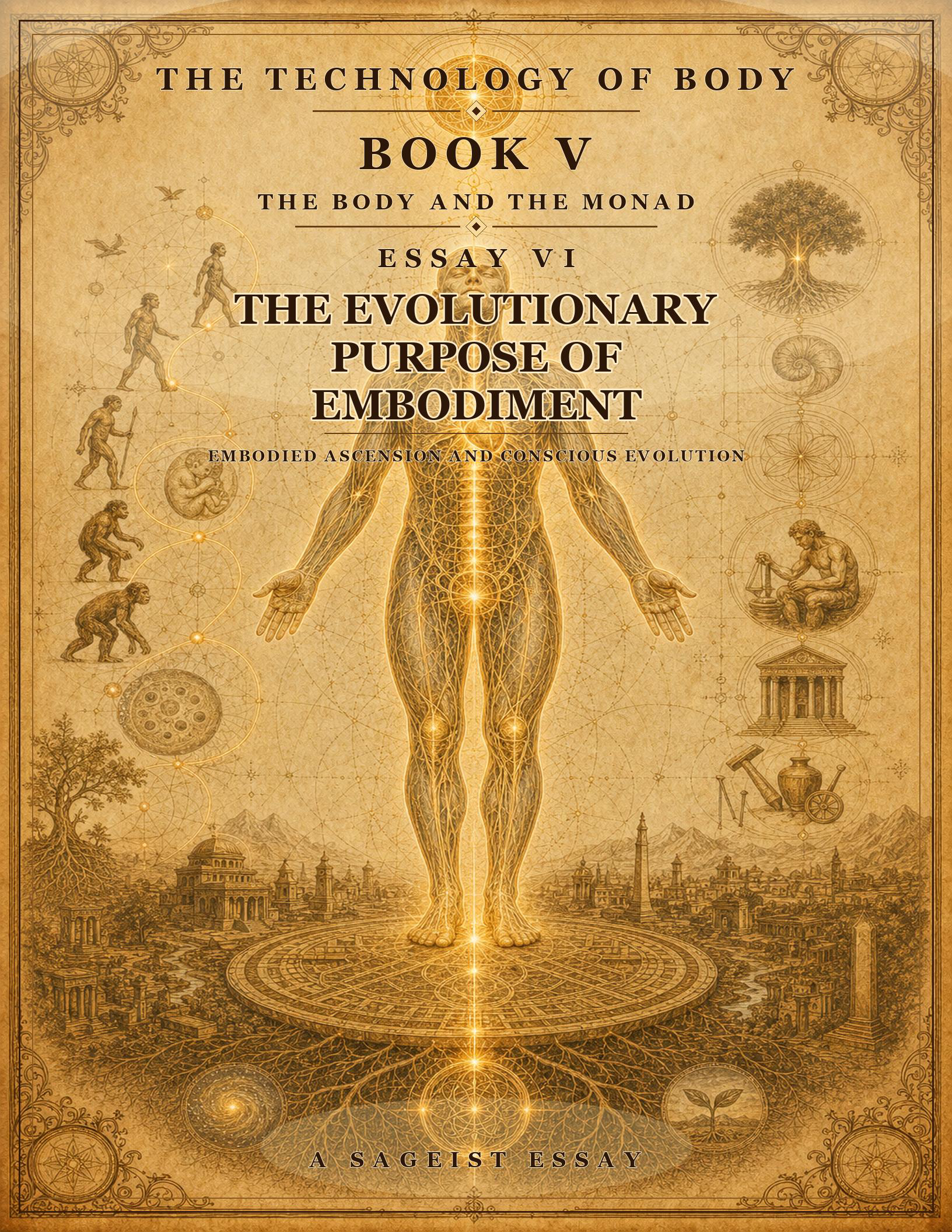
Human evolution is often measured biologically. Genetics change. Brains develop. Tools advance. Civilizations expand. Species adapt to environments, inherit traits, compete for survival, and alter the conditions of life. This is one layer of evolution. It is real, visible, measurable, and profound.
Yet biological evolution may not be the deepest form of development. The human being is not merely an animal that learned tools. Nor is civilization merely an extension of survival strategy. Something more mysterious moves through the human form: consciousness learning through embodiment, intelligence becoming responsible, the Monad entering limitation in order to develop capacities unavailable without incarnation.
Embodiment itself may serve evolutionary purpose. The body is not only the result of evolution. It is also a field through which evolution continues. Through the body, consciousness meets resistance, sensation, desire, fatigue, pain, discipline, love, death, time, beauty, memory, and consequence. These are not incidental conditions. They are the curriculum of incarnation.
The Monad enters physical existence not merely to survive. Survival is foundational, but it is not final. The organism must live, but human life asks for more than continuation. It asks for patience, discipline, compassion, creativity, responsibility, discernment, courage, humility, reverence, wisdom, and love. None emerge automatically. They develop through lived experience.
Without challenge there is no growth. Without limitation there is no discipline. Without suffering there is no compassion. Without desire there is no discernment. Without mortality there is no urgency. Without relationship there is no love. Without embodiment these capacities cannot mature. The body creates the conditions under which consciousness becomes tested.
The body therefore serves evolutionary function beyond biology. It creates friction, and friction creates development. Smoothness alone does not form strength. Ease alone does not produce wisdom. The muscle grows through resistance. The mind clarifies through question. The heart deepens through grief and devotion. The will matures through obstacle.
The body exposes consciousness to resistance. Resistance creates adaptation. Adaptation creates intelligence. Intelligence, when joined to soul, becomes wisdom. This process may represent the deeper purpose of incarnation itself. The Monad does not evolve despite the body. It evolves because of the body.
Human life becomes developmental architecture. Existence becomes curriculum. Every challenge becomes instruction. Every relationship becomes initiation. Every difficulty becomes opportunity for expansion. This does not mean suffering should be romanticized or injustice excused. It means consciousness can learn through conditions it did not choose.
Embodiment is not random existence. It is evolutionary design. The body places consciousness inside a world where every inner state must eventually meet consequence. Anger becomes action or restraint. Love becomes care or possession. Desire becomes creation or compulsion. Fear becomes wisdom or prison. Power becomes service or domination. The body forces metaphysics into ethics.
This is why incarnation is severe. It is not a fantasy of spirit floating above the world. It is consciousness entering weight. The body hungers. The body tires. The body ages. The body remembers. The body depends. The body can be wounded. The body can be healed. Through these conditions, consciousness learns humility.
Humility is evolutionary. It breaks the illusion that the self is self-made. Breath is borrowed. Food is received. Language is inherited. Knowledge is transmitted. The body is assembled from earth, water, fire, air, ancestry, and culture. The Monad enters a field it did not create alone. Embodiment teaches gratitude before philosophy can name it.
Discipline is also evolutionary. The body gives consciousness appetites, impulses, rhythms, and limitations. To mature, the human being must learn to guide these forces without hatred and without surrender. Discipline is not the rejection of the body. It is the ordering of the body so higher purposes can become visible.
Patience evolves through time. The body cannot be rushed beyond certain laws. Healing takes time. Strength takes time. Skill takes time. Trust takes time. Grief takes time. A seed cannot become a tree by command. Embodiment teaches consciousness that development is rhythmic, not merely willed.
Compassion evolves through vulnerability. A being without wounds may understand pain abstractly, but not intimately. The body makes the human being vulnerable to fear, illness, loss, fatigue, longing, and dependence. When consciousness enters this vulnerability without bitterness, compassion becomes possible. One recognizes the fragility of others because one has felt fragility within oneself.
Creativity evolves through limitation. Form forces imagination to become precise. A poem needs language. A building needs material. A song needs rhythm. A body needs gesture. A civilization needs structure. Without boundary, creativity remains vapor. The body teaches that spirit becomes powerful when it accepts form.
Responsibility evolves through consequence. In the body, choices matter. Sleep lost becomes fatigue. Food becomes chemistry. Words become memory in another nervous system. Touch becomes trust or wound. Labor becomes contribution or depletion. Repetition becomes habit. The body reveals that freedom without consequence is fantasy.
Discernment evolves through sensation. The body learns what nourishes and what harms, what opens and what contracts, what is safe and what is false, what is appetite and what is need, what is signal and what is noise. The mind may rationalize, but the organism often knows before the story catches up.
Wisdom evolves when all these capacities become integrated. Wisdom is not information stored in the mind. It is intelligence embodied as conduct. It appears in how a person speaks, eats, rests, builds, leads, loves, refuses, forgives, and dies. Wisdom is consciousness made trustworthy through form.
Book I revealed the body as the original technology. Book II revealed the nervous system as consciousness interface. Book III revealed symbolic physiology. Book IV revealed initiation as embodied transformation. Book V reveals the Monad moving through incarnation. Essay VI asks why the Monad would enter such a demanding field. The answer: development.
The Monad enters the body because certain capacities cannot be matured in abstraction. Courage requires fear. Forgiveness requires injury. Devotion requires something worthy of loyalty. Integrity requires temptation. Strength requires resistance. Mercy requires vulnerability. Beauty requires form. Love requires another.
The body is the place where these capacities become real. A person can imagine courage while safe, but courage is tested when the body trembles. A person can praise discipline while comfortable, but discipline is tested when appetite pulls. A person can speak of compassion while distant from pain, but compassion is tested when another's suffering interrupts convenience.
Embodiment removes the illusion of untested virtue. It brings consciousness into situations where the self is revealed. Pressure reveals pattern. Delay reveals patience. Loss reveals attachment. Power reveals character. Conflict reveals maturity. The body is the laboratory where the Monad discovers what has actually become integrated.
The evolutionary purpose of embodiment is not perfection. Perfection is static. Evolution is dynamic. The incarnate human is not asked to become flawless, but more conscious, more coherent, more responsible, more capable of love, more able to transform experience into wisdom. The path is not purity. It is integration.
This distinction matters because many spiritual systems confuse embodiment with contamination. They imagine that the highest path is escape from the conditions of human life. Sageism proposes a different vision: the body is not a fall from evolution. It is evolution's chamber. The human organism is the place where consciousness learns to become luminous under pressure.
Pressure is not always noble. Some pressure is unjust, excessive, cruel, or destructive. The doctrine must not use evolutionary language to excuse harm. A child should not be traumatized for growth. A people should not be oppressed for wisdom. Illness should not be romanticized. But when pressure exists, consciousness can still work within it, seeking transformation rather than mere repetition.
The body teaches adaptation. When conditions change, the organism adjusts. It regulates temperature, repairs tissue, mobilizes defense, conserves energy, learns movement, and rewires pathways. Adaptation is biological intelligence. At the psychological level, adaptation becomes strategy. At the spiritual level, adaptation can become initiation.
Yet adaptation can also become prison. A body adapted to danger may continue to live as if danger remains. A psyche adapted to rejection may interpret love as threat. A nervous system adapted to chaos may distrust peace. Evolution requires not only adaptation to old conditions, but reorganization when conditions change.
Healing is evolutionary reorganization. The person no longer needs the old armor in the same way. Breath changes. Posture changes. Perception changes. Relationship changes. The body learns a new possibility. Consciousness evolves when it can release adaptations that once preserved life but now restrict it.
This is why neuroplasticity belongs inside the doctrine. The nervous system can change through repeated practice, attention, relationship, and environment. The body is not fixed destiny. It is living architecture. Ritual, breath, movement, silence, nourishment, therapy, discipline, and love can alter the structures through which consciousness experiences the world.
The initiate participates in evolution consciously. Rather than being shaped only by accident, media, trauma, appetite, and inherited pattern, the initiate becomes a designer of the inner organism. The Sageist asks: what is this practice evolving in me? What kind of nervous system is this environment building? What kind of body is this civilization producing? What kind of human will these habits create?
Human evolution has always included tools. The hand shaped stone. Stone shaped hunting. Hunting shaped cooperation. Fire shaped diet, community, myth, and night. Language shaped memory. Writing shaped civilization. Machines shaped labor. Digital systems shaped attention. Tools extend the body, but they also train consciousness.
The danger is that external tools may evolve faster than internal capacities. Power without wisdom becomes destruction. Intelligence without soul becomes extraction. Technology without embodiment becomes dissociation. A civilization may become technically advanced while emotionally primitive, spiritually confused, and physiologically dysregulated.
Therefore the next stage of evolution cannot be merely technological. It must be embodied. Humanity must evolve regulation, attention, compassion, discernment, ecological literacy, symbolic intelligence, and self-governance. The future human is not only enhanced by devices. The future human is refined through consciousness entering the body more completely.
This does not reject technology. Sageism does not worship primitivism. Tools are part of human evolution. But tools must serve the integrated human rather than replace the developmental work of embodiment. A device can measure breath, but it cannot become breath for the person. A platform can connect messages, but it cannot become presence. A machine can calculate, but it cannot mature conscience.
The body remains the irreplaceable site of human development. It is where empathy is learned through sensation, where mortality gives value to time, where pain teaches vulnerability, where pleasure teaches discernment, where discipline shapes freedom, where relationship becomes embodied, and where the Monad encounters consequence.
Sports, martial disciplines, dance, craft, and movement reveal this evolutionary purpose clearly. The athlete learns that capacity develops through repetition, resistance, feedback, failure, recovery, and focus. The body becomes teacher. Performance becomes consciousness under pressure. Excellence becomes the visible result of integrated attention, nervous system regulation, and disciplined practice.
This is why movement can become initiation. A movement repeated consciously becomes a pathway. A posture held truthfully becomes a question. A breath taken under pressure becomes training. A skill refined over years becomes philosophy. The body evolves not by wishing for capacity, but by practicing the conditions that produce it.
The same is true of moral development. Virtue is practiced under pressure. Patience is trained when delay irritates the body. Honesty is trained when the voice risks consequence. Compassion is trained when another's pain becomes inconvenient. Courage is trained when fear is present. Responsibility is trained when no audience applauds.
The body is where moral philosophy becomes real. The nervous system must tolerate discomfort to tell the truth. The throat must open. The heart must remain available. The spine must hold. The hands must refrain from harm or move toward repair. Morality is not disembodied. Ethics has posture, breath, and muscle.
Relationships are evolutionary technologies because they expose unfinished development. Intimacy reveals attachment. Conflict reveals regulation. Parenting reveals patience. Friendship reveals loyalty. Community reveals responsibility. Leadership reveals shadow. Love reveals whether the self can remain centered while honoring another center.
The Monad evolves through relationship because relationship challenges self-enclosure. Another person interrupts the fantasy of isolation. Their needs, limits, pain, dignity, and mystery require response. Love is one of the great evolutionary forces because it asks consciousness to expand beyond self-reference without losing center.
Suffering can also become evolutionary, though never automatically. Pain can embitter or deepen. Loss can close the heart or open it. Failure can humiliate the ego or clarify the path. Illness can create despair or awaken reverence. The difference lies in whether consciousness enters the experience and metabolizes it into wisdom.
Metabolizing experience is one of the body's deepest symbols. The gut takes what is external and transforms it into usable life. Consciousness must do the same with experience. It must digest joy, pain, memory, failure, praise, criticism, love, and death. Undigested experience becomes toxin. Integrated experience becomes strength.
The body is therefore an alchemical vessel. It receives the raw material of life and transforms it through heat, pressure, rhythm, and time. Ancient alchemy spoke in metals and fires, but the human organism performs the mystery daily. The lead of suffering can become the gold of wisdom when consciousness participates.
This alchemy requires attention. Experience alone does not guarantee development. Many people repeat pain without learning. Many repeat success without maturing. Many age without becoming wise. Evolution requires reflection, embodiment, humility, practice, and integration. Time is not enough. Conscious participation is required.
The civilizational implications are immense. If embodiment has evolutionary purpose, then society must be designed to cultivate development rather than merely consumption. Schools should train attention, regulation, craft, ethics, movement, beauty, and symbolic literacy. Work should develop contribution rather than simply extract energy. Medicine should support the whole human organism. Technology should respect embodiment.
Architecture should also participate in evolution. Spaces can train posture, mood, attention, reverence, and social relation. A built environment can either dull the body or awaken it. Sacred architecture was never merely aesthetic. It was developmental psychology in stone. The future city must become an evolutionary environment.
Economics must be judged by the humans it produces. Does an economy cultivate dignity, responsibility, skill, generosity, and health? Or does it produce anxiety, addiction, exhaustion, comparison, and alienation? A system that grows numbers while shrinking the human being is not evolutionary. It is regression with machinery.
Media must be judged the same way. What does this content evolve in the nervous system? Outrage? Envy? Fear? Attention? Courage? Depth? The repeated inputs of civilization become the developmental environment of the collective body. A culture becomes what it repeatedly feeds consciousness.
The future human will need to choose inputs as carefully as food. Information becomes mental nutrition. Sound becomes nervous system atmosphere. Images become symbolic diet. Relationships become emotional ecology. Habits become architecture. The body evolves according to what it repeatedly receives, practices, and becomes.
The evolutionary purpose of embodiment also reframes aging. Aging is not only decline. It is the visible passage of time through form. The body changes, and the Monad is invited to release vanity, deepen essence, refine priorities, and transmit wisdom. A culture that worships youth often fails to understand the evolutionary role of elderhood.
The elder is not merely an older body. Ideally, the elder is embodied memory, digested experience, moderated desire, long-tested patience, and transmission. When elderhood collapses, civilization loses its deep nervous system. Youth becomes energetic but unguided. Power becomes impatient. Innovation forgets consequence.
Death completes the curriculum. It teaches that form is temporary, and therefore sacred. Every body returns. Every role dissolves. Every possession is released. The question becomes: what did consciousness develop through this embodiment? What did the Monad make visible? What wisdom was transmitted? What love became real?
The solar human is one who has allowed embodiment to evolve consciousness rather than merely decorate identity. Such a person is not free from difficulty. They have become more luminous through difficulty. Their body carries discipline without hardness, compassion without weakness, presence without performance, and power without domination.
This is the future archetype of humanity: not a disembodied intelligence escaping biology, but an integrated being in whom biology, psychology, spirit, symbol, technology, and civilization are brought into coherence. The body is not discarded. It is refined. The Monad is not trapped. It is expressed.
Essay VI closes with this recognition: embodiment is evolutionary design. The body creates friction, and friction creates development. The Monad enters limitation so patience, discipline, compassion, creativity, responsibility, discernment, and wisdom can become real. Human life becomes developmental architecture.
The gate closes here: existence is curriculum. Every challenge becomes instruction. Every relationship becomes initiation. Every difficulty becomes opportunity for expansion. The Monad does not evolve despite the body. It evolves because of the body, and the body becomes the sacred instrument through which consciousness learns how to become wise.